

the cereal conundrum
determining the perfect ratio of cereal to milk to minimize milk waste and prevent over-consumption

The Cereal Conundrum: Determining the Perfect Ratio of Cereal to Milk to Minimize Milk Waste and Prevent Over-consumption
Amy Lee, Royal Academy of Antwerp, In Situ
Abstract
I despise the milk that remains after eating a bowl of cereal. I refuse to drink leftover cereal milk in large quantities. First, I dislike the taste of milk, regardless of whether that milk is dairy milk or plant-based milk. Secondly, depending on the type of cereal, the milk takes on an even stranger flavor and texture than unadulterated milk, becoming much too saccharine and more viscous (from the starches in the cereal, I assume). In addition, the warmer-than-starting temperature of the milk is unsettling and nauseating. Wasting a large quantity of milk, however gross, is out of the question. When left with a bowl half full of milk, in an effort to reduce waste in conjunction with my refusal to drink said milk, I add more cereal to the bowl to slowly chip away at the remaining volume, which leads to eating more cereal than I intended or am comfortable with eating. This is a problem. A problem that leads me to a very pressing question, which I attempt to answer in this paper: How much milk do I need for a perfectly satiating portion of cereal such that at the point of satiation, there remains minimal milk waste?
Introduction
Food waste and over-consumption are two critical issues with dire consequences playing out in real-time. Future projections and a look at the trajectory we are heading in promise an even more sinister reality than the one we are living in today. While they are differentiated as two separate issues, over-consumption and food waste are undoubtedly linked in a causal relationship (over-consumption → food waste). While the scale of these issues cannot be effectively ameliorated by something as negligible as cereal and milk eating patterns—the concern of this paper—I believe this example, as inane as it is, illustrates the core of both issues and pushes for an increased cognizance for consuming only what is necessary.
Each year, 1.3 billion tons of food are wasted, which amounts to roughly a third of all food produced each year. In the US alone, 60 million tons are wasted per year, ranking the country first in food waste generation. The primary source of food waste occurs at the production and processing levels accounting for 33% of total waste, but a significant portion of waste occurs at the consumer levels as well at around 17%. Each year, Americans waste $408 billion on food, with dairy being the item tossed out in the greatest quantity. The vast majority of this waste is sent to landfills, making up approximately one-fourth of the municipal solid waste (MSW) in US landfills. Only 5% of that waste is recovered for composting. The rest decompose on site and release methane (CH4) and other greenhouse gasses like carbon dioxide and chlorofluorocarbons. Emissions from landfill food are responsible for 11% of the world’s total emissions and is a major contributor to global warming. It is responsible for a slew of other issues as well, such as food scarcity and economic issues. Knowing all of this, it feels unconscionable to throw out my leftover cereal milk.
The first problem that comes to mind with regards to over-consumption is the rising rate of obesity, otherwise referred to as “the obesity pandemic”. Data from 2019 reported a rate of obesity in 35.7% of Americans and 52.7% of Europeans. Between 1975 and 2016, the rate of obesity tripled globally. The reasons for this trend are multi-fold. First, we are seeing an increase in sedentary lifestyles due to jobs requiring far less physical demand and involving little more than sitting in front of a computer screen. In addition, for many, leisure time is spent on social media and video games, among other stationary activities, virtually eclipsing many of the physically-involved hobbies that were more commonplace prior to the rise of technology.
However, while physical activity decreased, availability of food—especially “high-quality” and calorically dense foods such as meat, dairy, eggs—increased. Data from the Food and Agriculture Organization of the United Nations in 2000 reported a 3000 kcal/day/capita food availability at the retail level (i.e. grocery stores) in developed countries, with the US ranking first at 3600 kcal/day/capita, closely followed by Europe at 3500 kcal/day/capita. However, the average female adult only requires about 1500-2000 kcal/day, while the average male adult requires 2000-2600 kcal/day. These statistics show that food availability exceeds nutritional needs by approximately 1000 kcal/day/capita. Factoring in unavoidable food loss, the difference between need and availability rings in at around 700 kcal/day/capita, which either becomes food waste or over-consumption.
Food waste and over-consumption are deeply intertwined and rooted in a multitude of complex issues that are impossible to exhaust within the scope of this paper. To briefly recap the presented information above, food is produced in gross excess and wasted—approximately 1.3 billion tons per year globally—with most of the waste (33%) occurring at the production level. Even after these losses, groceries are able to be stocked at an excess of 30%, or at an amount 30% higher than is required to meet nutritional needs. Overstocked shelves in addition to a plethora of other factors affecting consumer behavior lead to people purchasing more food than they physically require—approximately 700 kcal/day in excess—which are either wasted or consumed beyond their daily recommended intake, leading to great quantities of food in landfills and the rising rate of obesity. The effects of overproduction, over-consumption, and waste are comprehensive and highly consequential, giving rise to environmental, economic, social, and health issues, to name a few.
The reason why I provide such context preceding a paper that has to do with something as inconsequential and inane as cereal eating patterns is because my issue with milk waste, as trivial and oddly specific as it seems, can be attributed to the broader guilt I feel with respect to wasting food. I wanted to inform the reader of the concrete underpinnings of this guilt and the situations unfolding before us so as to raise awareness for our consumer habits. Of course, there are other personal reasons that inspired this paper such as refusing to drink cereal milk and refusing to eat more cereal than I am physically comfortable with eating. I suppose this paper would not have come about had I had no problem drinking cereal milk. With that being said, this paper is ultimately very personal and potentially useless for many of those reading. For myself, however, I am finally solving a mildly annoying issue that has persisted (and has never been answered, until now!) since the beginning of my cereal-eating journey as well as indulging in hyper-fixating and obsessing over whatever my attention chooses to land on.
In the following sections of this paper, I detail the problem at hand, outline the parameters and conditions and perform an initial data collection to determine the necessary calculations, perform said calculations, and test the generated numbers on whether they meet the conditions set at the beginning of this investigation.
Study Objectives
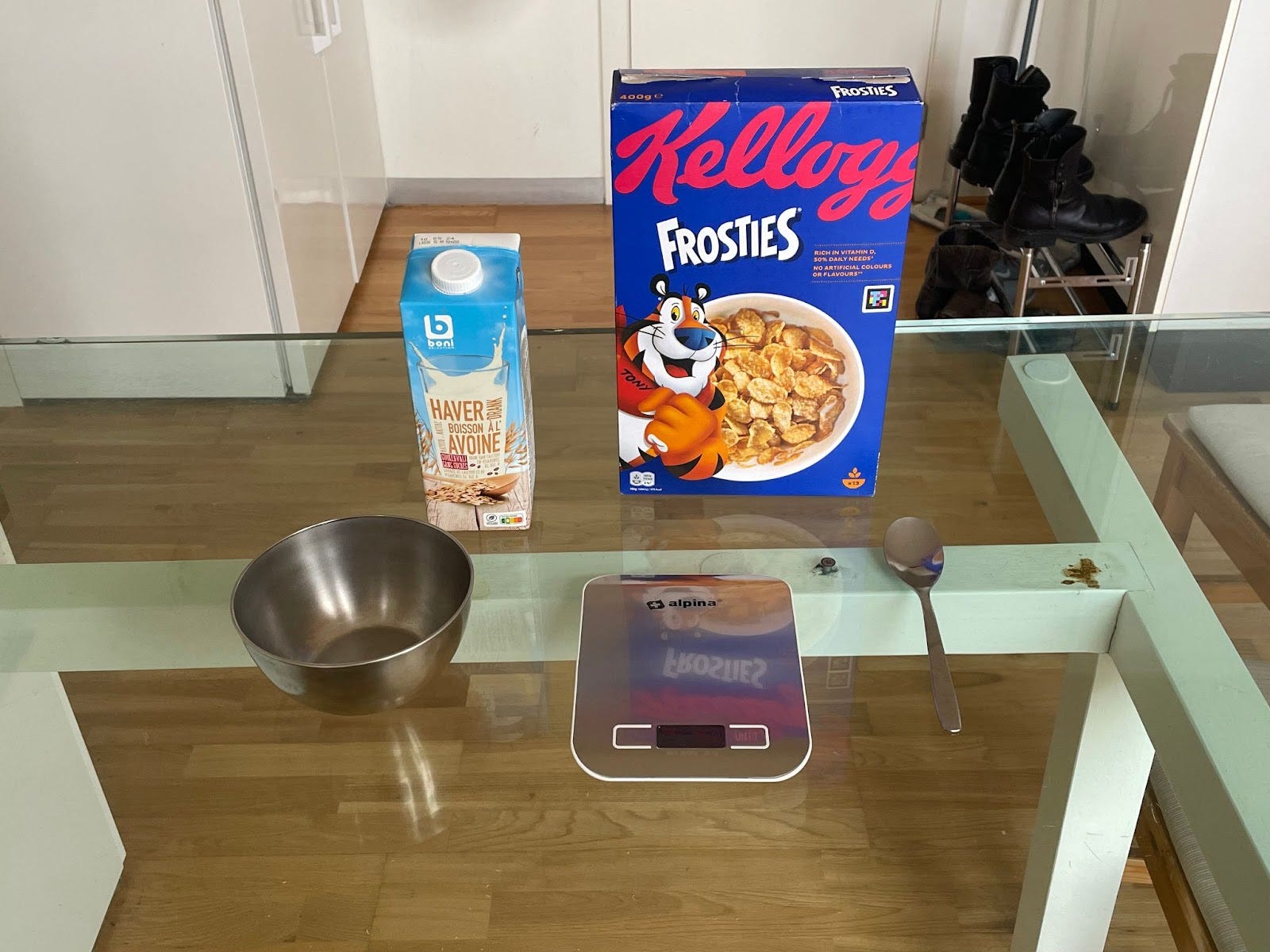
This investigation aims to determine the ideal quantity of milk necessary to finish a fixed portion of cereal, with minimal milk waste at the end of the eating session. Answering this question is dependent on a multitude of factors that are very individual, such as my eating patterns and preferences, which I quantify for the following calculations. In addition, factors such as cereal type and dimensions of the bowl and spoon used can affect the results of these calculations. These values will vary from person-to-person, however, the calculations performed can be adapted to any cereal consumer and generate values suitable to their unique patterns and preferences as well as choice of cereal and equipment. For the sake of conducting this investigation, Frosted Flakes was the cereal of ch oice eaten from a generic stainless steel bowl using a stainless steel spoon from IKEA.
Method
First, it was important to determine how much milk I would be willing to waste or drink at maximum. I determined that amount to be at most 20 grams of milk. Then, I needed to set a fixed portion of cereal I am usually willing to eat, 50 grams of cereal solids.
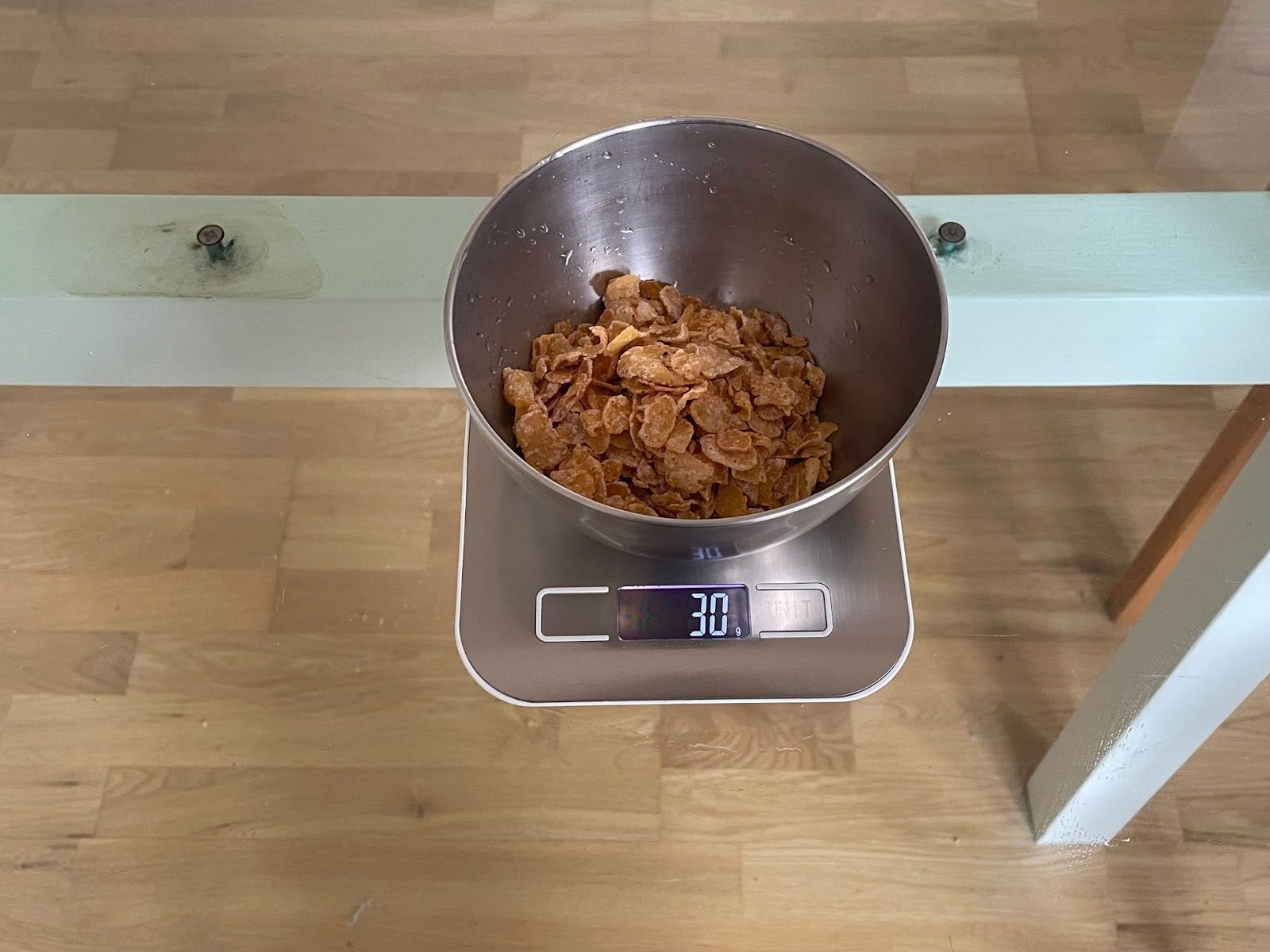
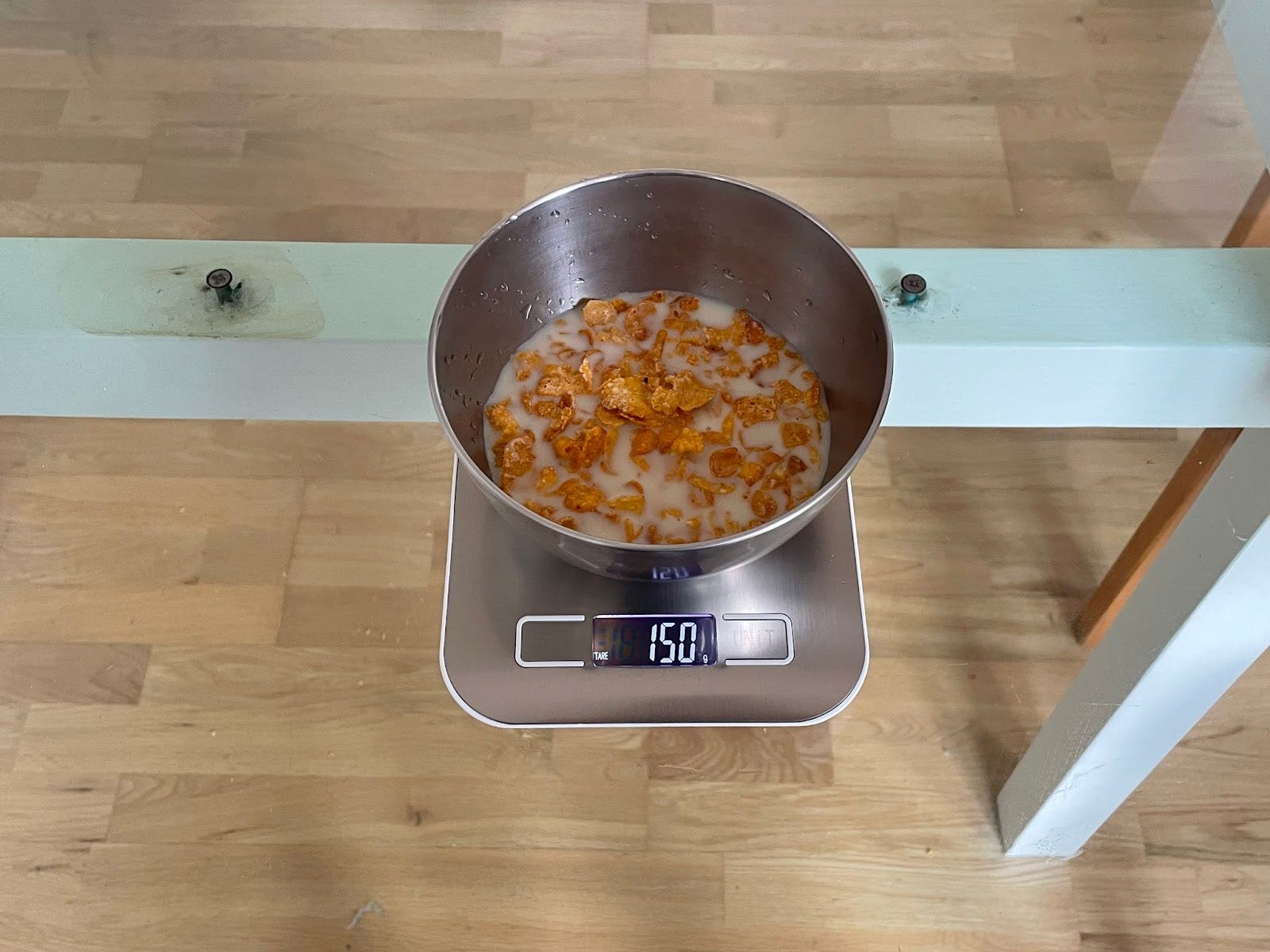
Another important question relating to the quality of the cereal-eating experience was answered as well. Namely, I wanted to know how much milk is required to adequately submerge a portion of cereal. There can neither be too much milk nor too little milk. Too much milk causes the cereal to disperse too much throughout the bowl, making it difficult to get a satisfying spoonful that is not overwhelmingly milky. Too little milk results in a dry and overly crunchy spoonful of cereal, which scrapes at the roof of the mouth and lends itself to a rather painful eating experience. Performing a visual test to determine the amount of milk for ideal cereal submersion, milk was poured into a bowl containing 30 grams of Frosted Flakes (an arbitrary amount). I stopped pouring the milk as soon as it appeared to cover the flakes to my liking, which amounted to 150g milk. Conducting a second test with a portion of 20g cereal, 102g milk seemed to satisfy my submersion preference. Thus, I concluded a milk-to-cereal ratio of approximately 5:1 was necessary to cover any given portion of cereal.
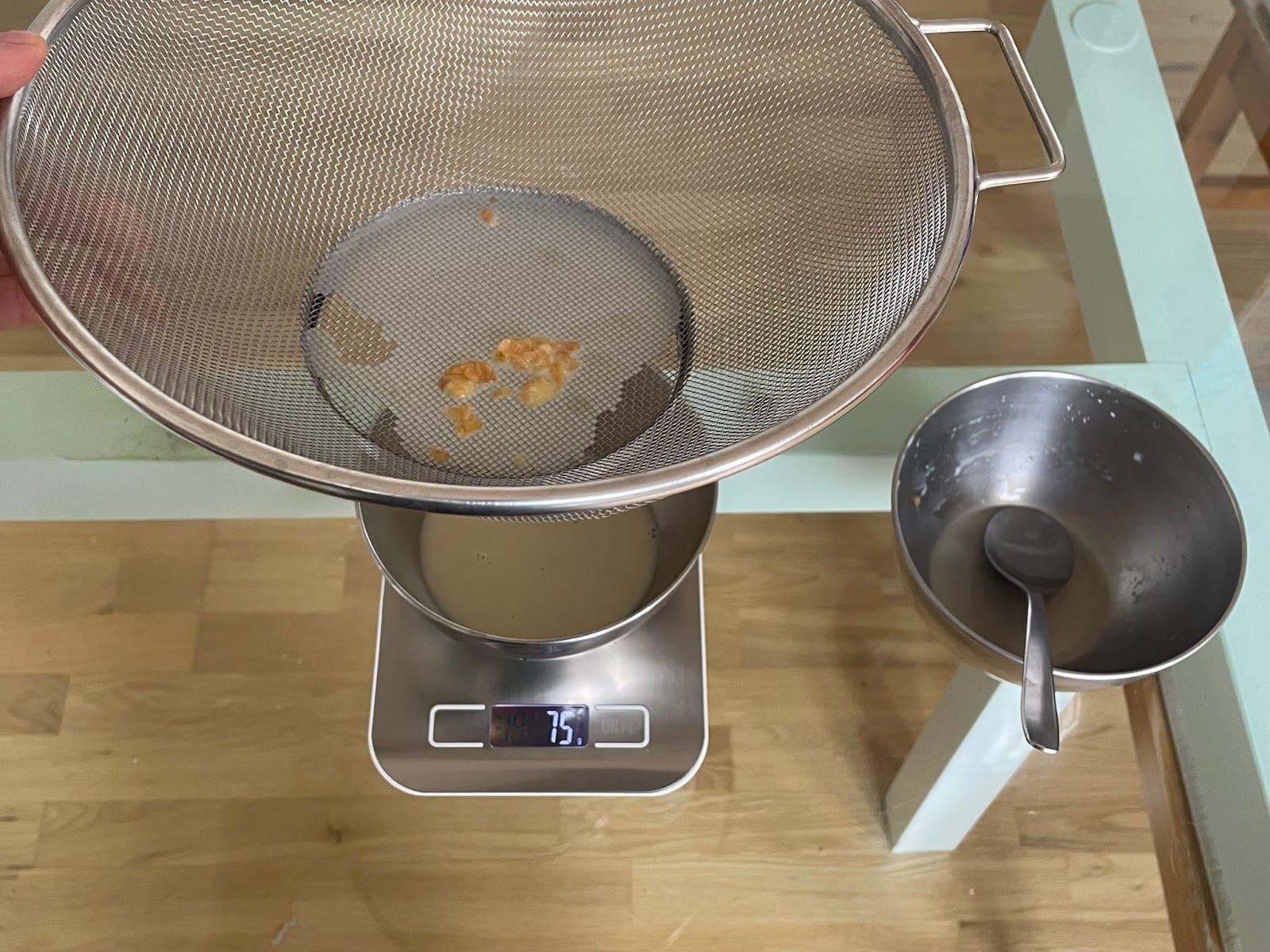
The following question was also crucial to this investigation—how much milk to cereal actually reaches the mouth and gets consumed? A test with a bowl containing 150g milk and 30g cereal (following the 5:1 submersion ratio) was conducted to determine the “consumption ratio” (see Image 1). The entirety of 30g of cereal was consumed and following this, the remaining milk was weighed. A total of 75g milk remained in the bowl (see Image 2), and 75g milk was consumed along with the 30g cereal. Another trial was performed with 102g milk and 20g cereal, which yielded 50g milk remaining. Thus, I tend to consume approximately 2.5g milk per gram of cereal.
Given the discrepancies in the submersion and consumption ratios, we know that more milk is poured into the bowl than is actually consumed. Therefore, there will always be leftover milk for any given bowl of cereal following these two ratios.
Based on the consumption ratio of 2.5:1 milk to cereal, the amount of milk it takes to finish the ideal portion of 50g cereal would be 125g. However, 125g milk would be too little milk to adequately submerge the entire portion of cereal. According to the submersion ratio, 250g milk is required for 50g cereal to be covered. If I submerged a bowl of 50g cereal with 250g milk, however, then I would be left with 125g milk waste, which far exceeds the maximum of 20g.
It follows then that it is impossible to eat the ideal portion of 50g cereal in a single bowl without generating excessive waste and therefore must be split into multiple helpings.
Another thing to note is that the more you replenish the same bowl with the same milk, the sweeter and warmer the milk becomes, leading to a decline in enjoyment in subsequent helpings of cereal. Based on past experiences, the milk becomes much too sweet to continue eating from after around 3 helpings. Therefore, I set my maximum number of helpings to 3.
With all of these conditions in mind, we can proceed with the calculations. Below is a list of all values determined and used in the calculations:
Submersion ratio: 5:1
Consumption ratio: 2.5:1
Allowed milk waste: ≤ 20g
Maximum helpings: 3
Ideal cereal portion: 50g

Calculations
Cereal variables
c1 = starting amount of cereal in first helping
c2 = starting amount of cereal in second helping
c3 = starting amount of cereal in third helping
c4 = starting amount of cereal in fourth helping = 0*
c1 + c2 + c3 = 50g cereal
*the fourth helping will not contain any more cereal since the aim is to finish the cereal within 3 helpings
Starting milk variables
ms1 = starting amount of milk in first helping
ms2 = starting amount of milk in second helping
ms3 = starting amount of milk in third helping
ms4 = final amount of milk remaining
Milk consumed variable
mcon1 = milk consumed with first helping
mcon1 = milk consumed with second helping
mcon1 = milk consumed with third helping
Following submersion ratio of 5:1,
ms1 = 5c1
Following consumed ratio of 2.5:1,
mcon1 = 2.5c1
Subtracting to get the remaining milk after the first helping, or the starting amount of milk in the second helping (ms2 ),
ms1 = mcon1 = ms2
Then,
ms2 = 5c2
So,
ms1 - mcon1 = 5c2
And,
ms1 = 5c1 and mcon1 = 2.5c1
Therefore,
5c1 - 2.5c1 = 5c2
c1 = 2c2
Repeat operation to find that c2 = 2c3
The ratio of 5c2 to 5c2 to 5c2 is thus
c1 = 2c2 = 4c3
Knowing c1 + c2 + c3 = 50g cereal and c1 = 2c2 = 4c3, we can calculate the amount of cereal needed in each helping:
c1 = 28.57g cereal in first helping
c2 = 14.29g cereal in second helping
c3 = 7.14g cereal in third helping
Since the submersion ratio is 5:1, you’ll need 5 times the amount of cereal for milk. In order to finish 50g cereal, you’ll need:
5c1 = 5(28.57) = 142.86g milk
Once you finish the last of the remaining cereal, you will be left with 17.86g milk, which lies within the range of acceptable milk waste values (≤ 20g).
Since c3 = 7.14g and ms3 = 5c3
ms3 = 5(7.14) = 35.71g milk in third helping
mcon3 = 2.5c3 = 2.5(7.14) = 17.86g milk consumed
Therefore,
ms4 = ms3 - mcon3 = 35.71 - 17.86 = 17.86g milk waste
To conclude, to eat 50g of Frosted Flakes cereal, I will need 142.86g milk to eat 28.57g, 14.29g, and 7.14g of cereal respectively across three helpings which will result in only 17.86g milk waste, a quantity I do not mind drinking to finish off.
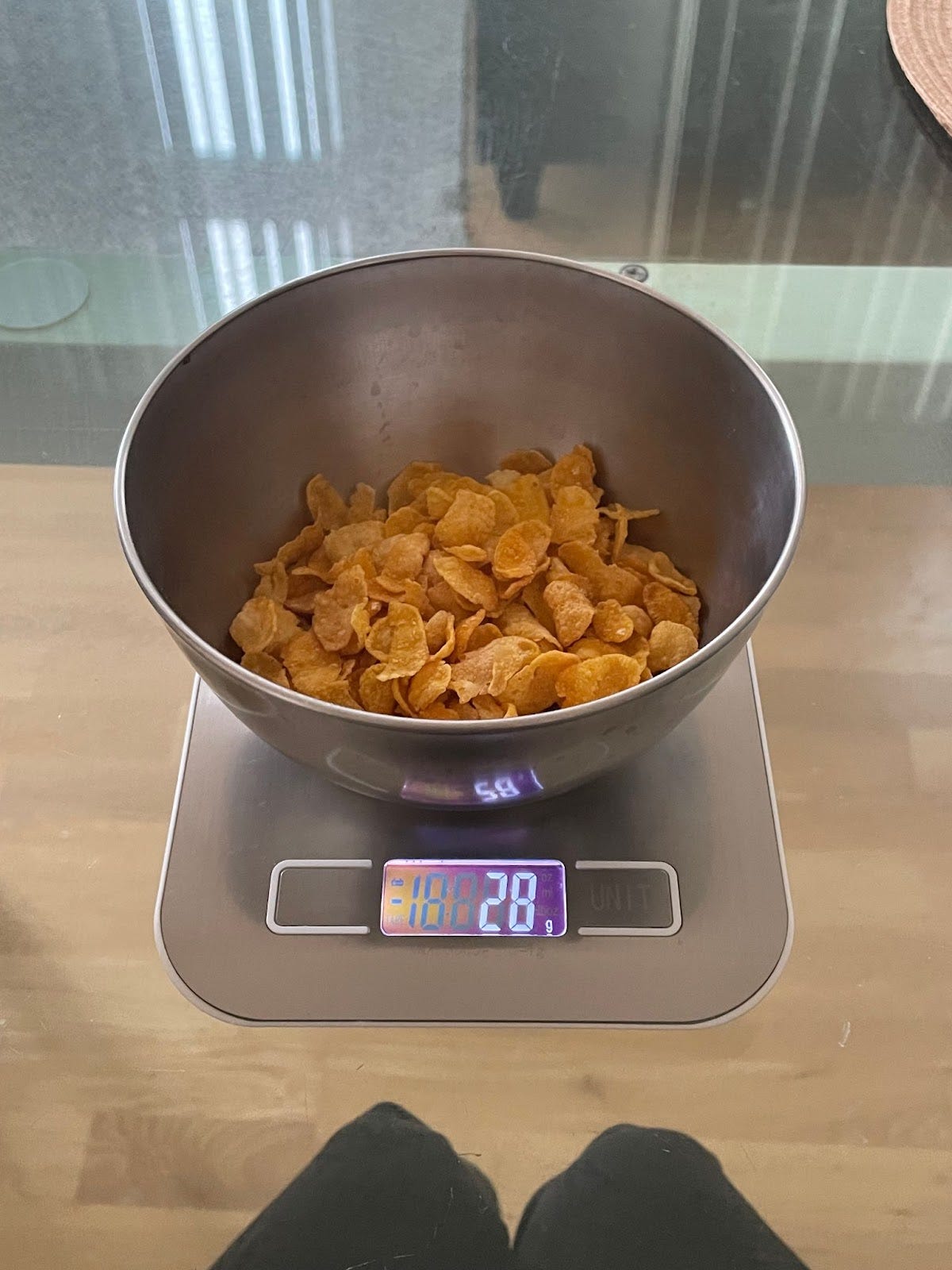
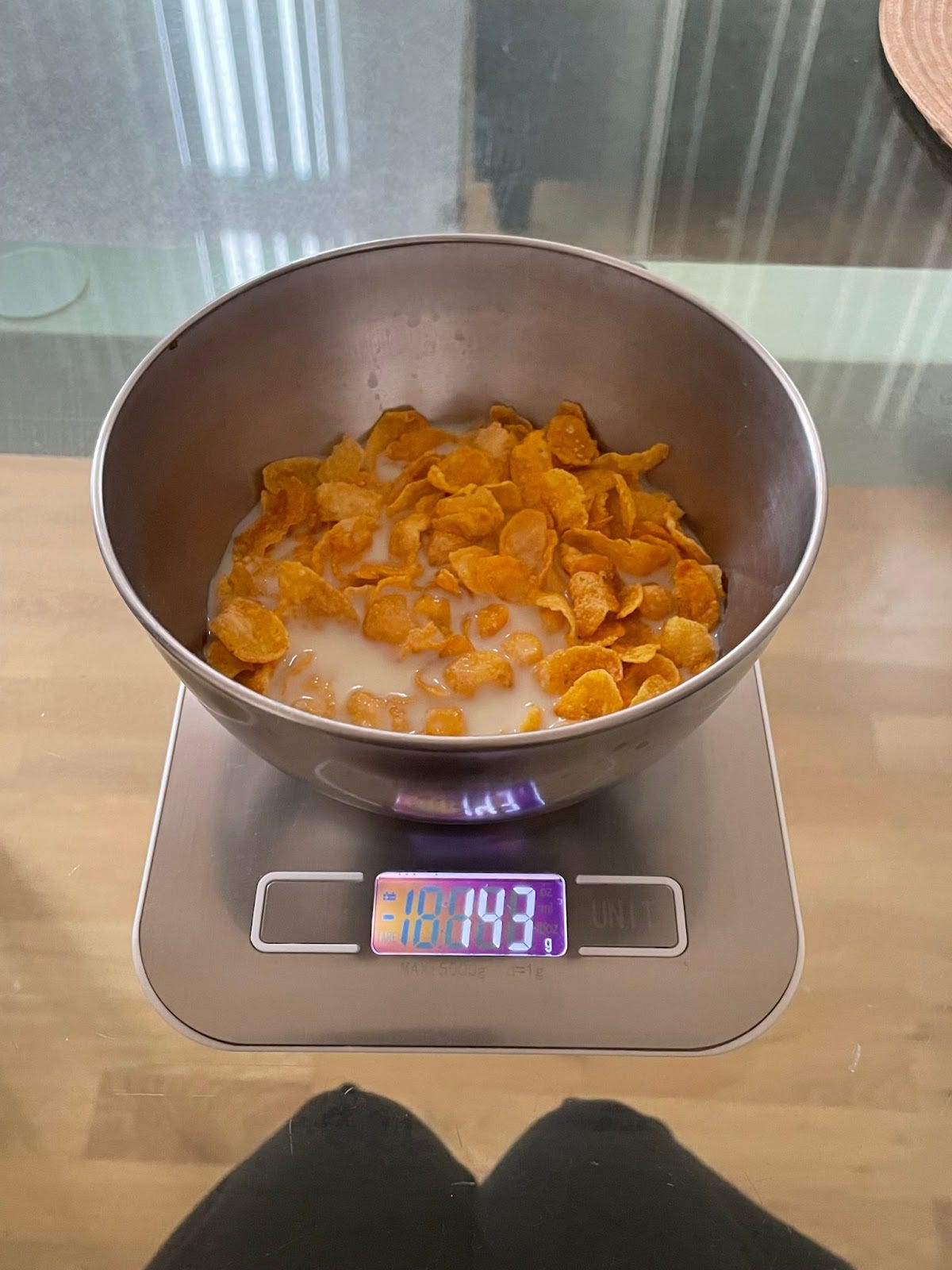
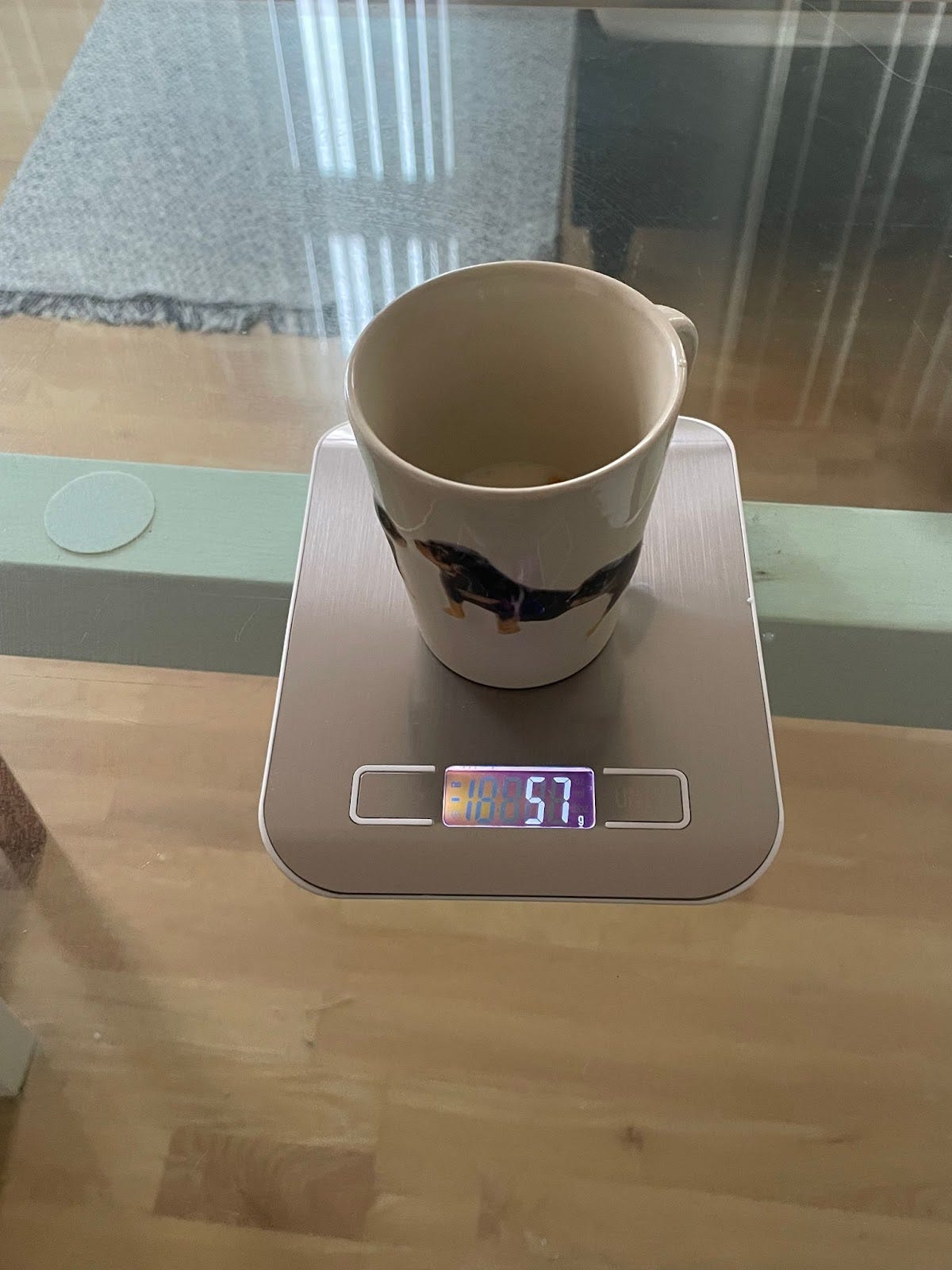
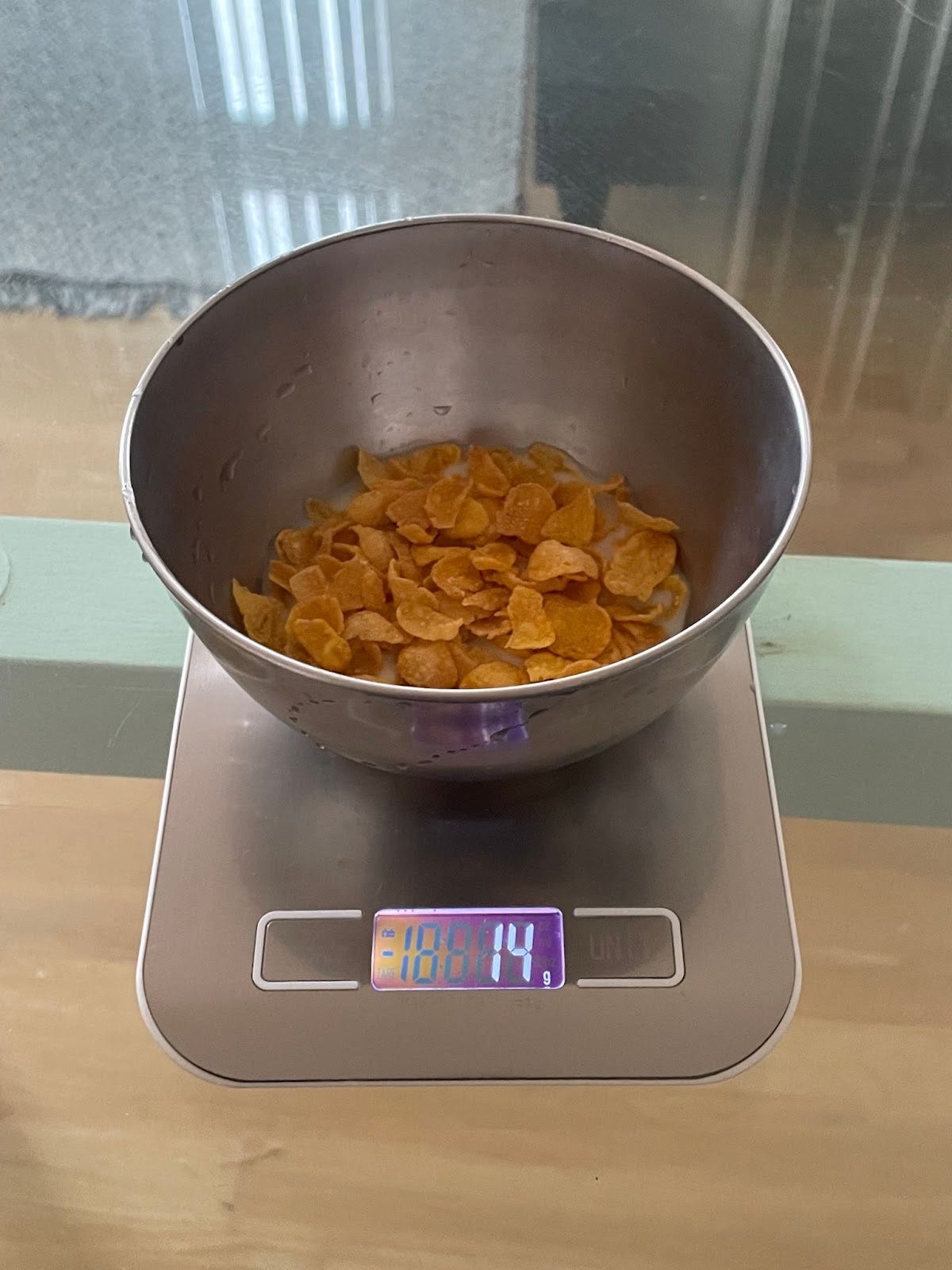
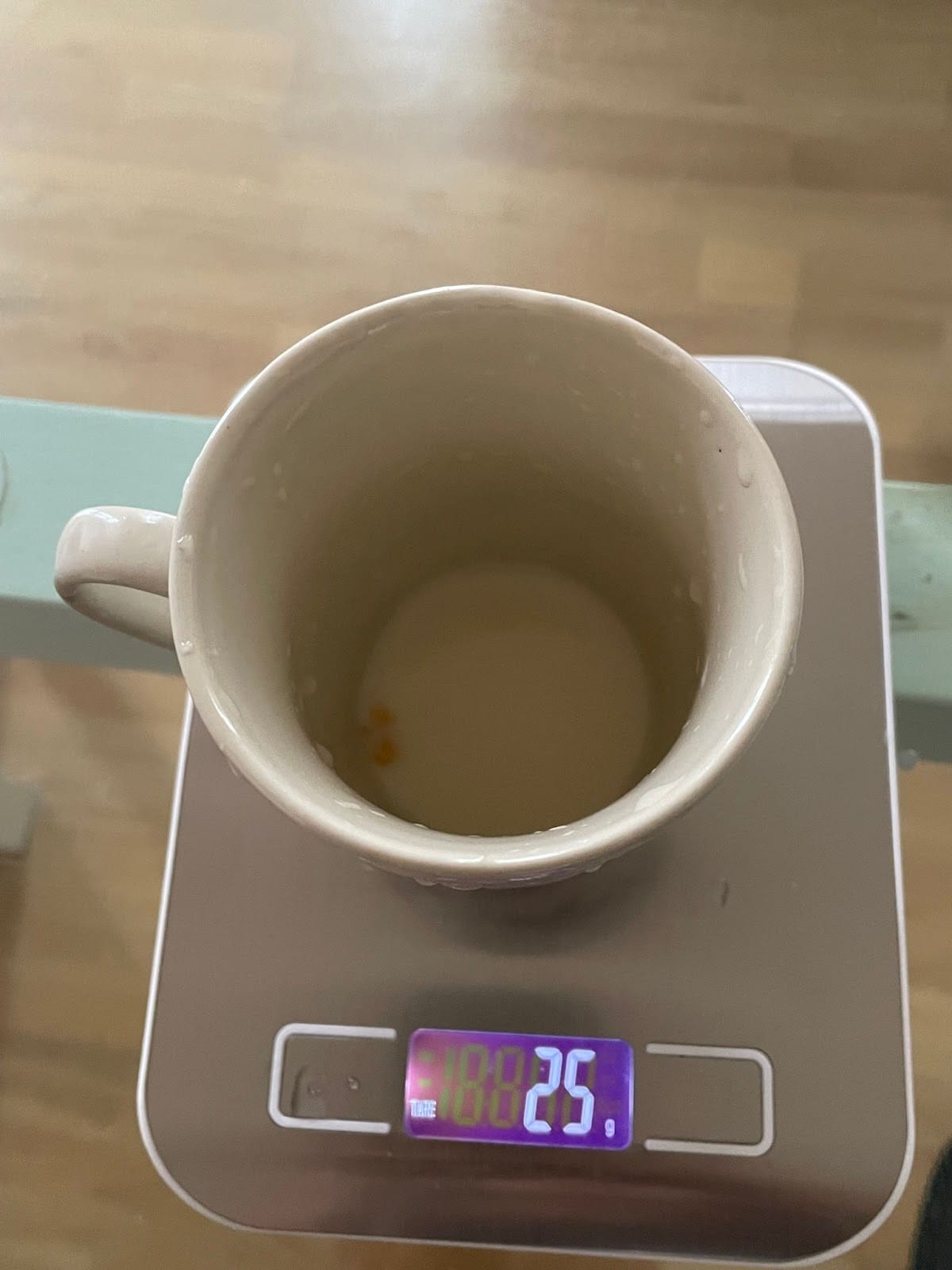
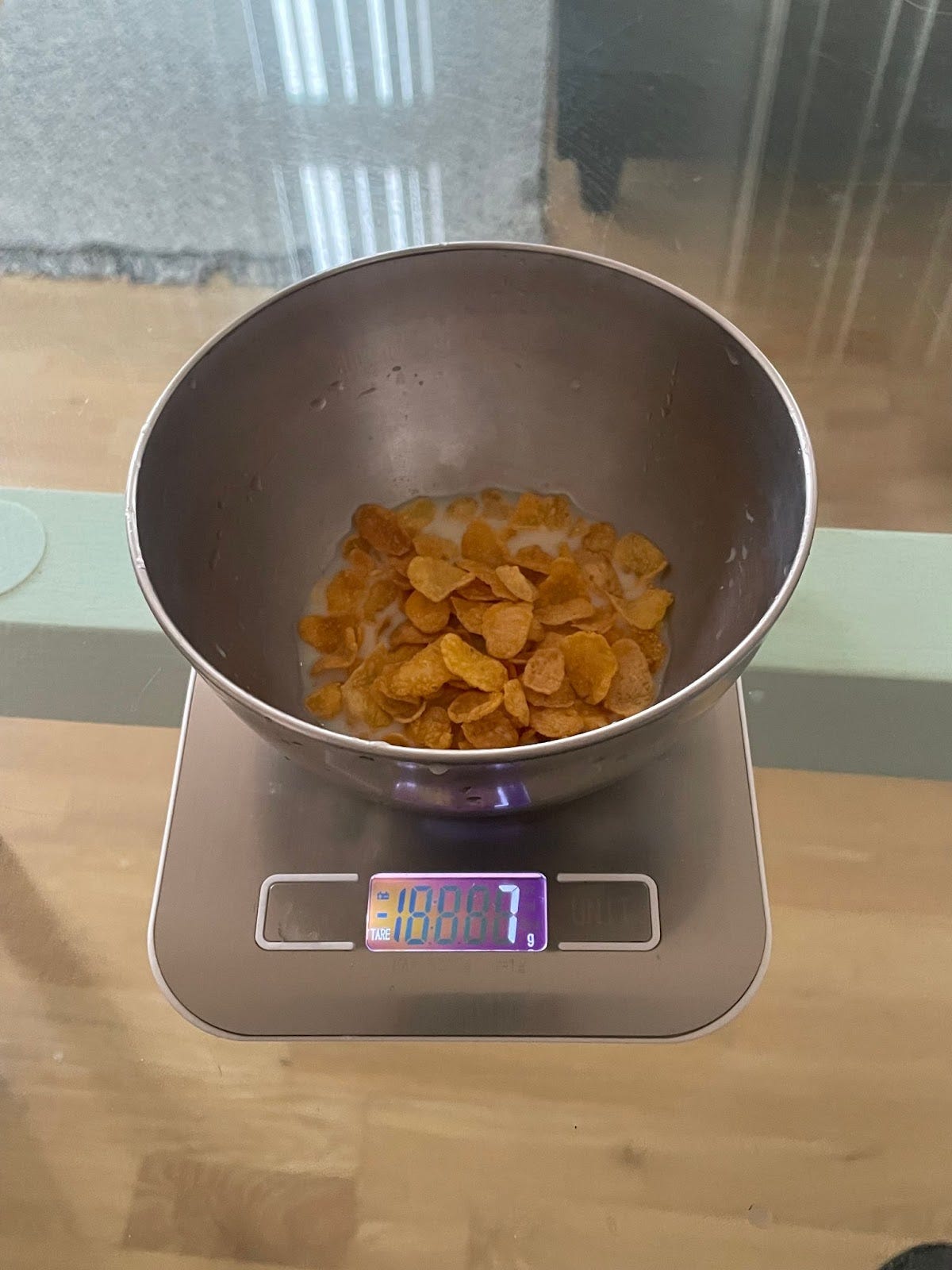
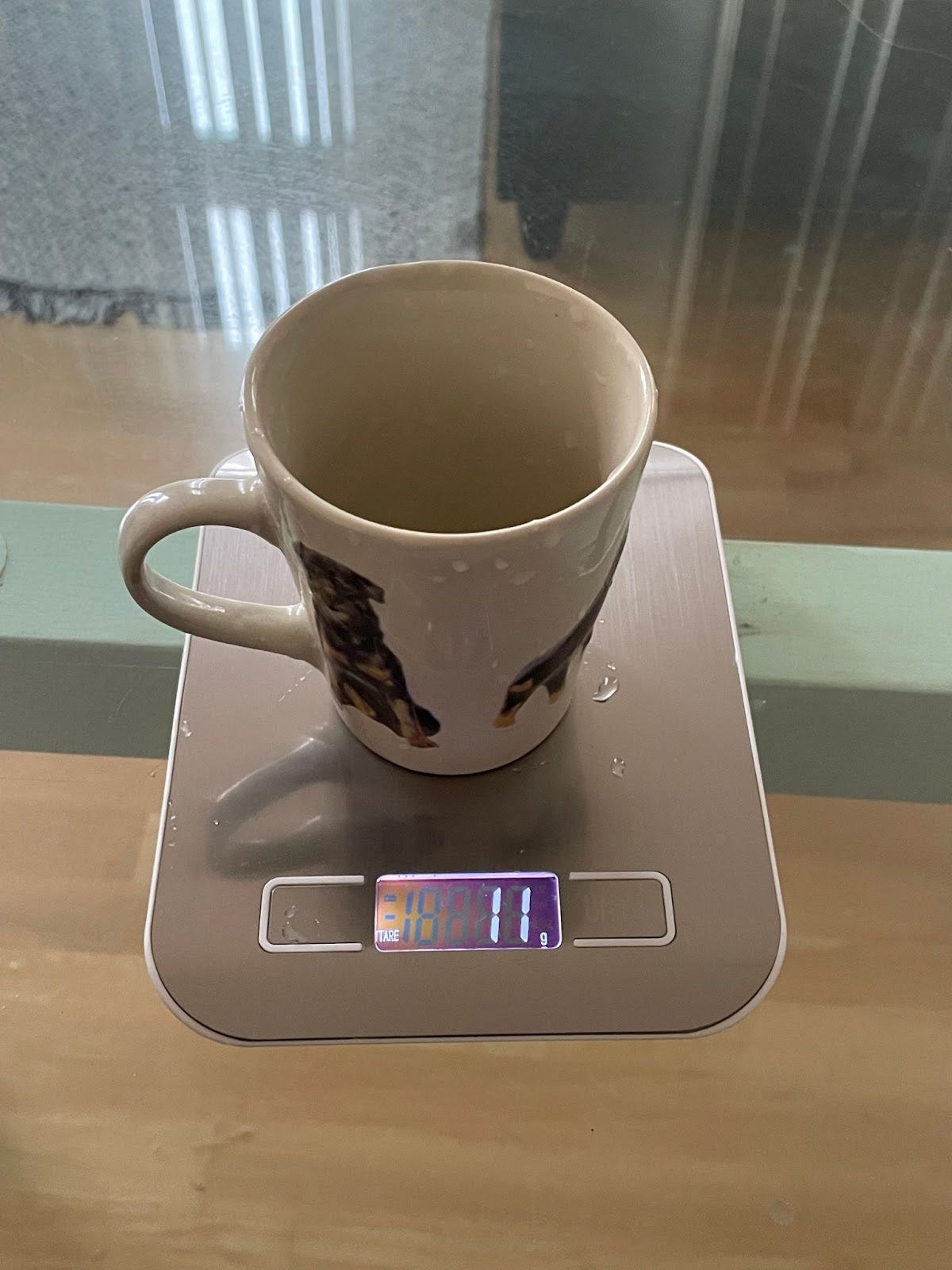
Since variability is inevitable in something as imprecise as cereal eating patterns, I decided to put the calculations to the test. In a bowl, I started with a helping of 29g cereal (rounded up from 28.57g) and 143g milk (rounded up from 142.86g). Upon finishing the first helping, I weighed the remaining milk, which came out to 57g. To this milk, I added 14g cereal (rounded down from 14.29g). I repeated the process of eating and weighing the remaining milk, which came to 25g by the end of the second helping. For the third helping, I added 7g cereal (rounded down from 7.14g) to the remaining milk. Upon finishing the third helping, a mere 11g milk remained (see Images 1-9). Therefore, despite the slight variability in values between this test and the previous test, both tests yielded a milk waste within the acceptable range as well as maintained an acceptable submersion ratio throughout each of the three helpings.
Discussion
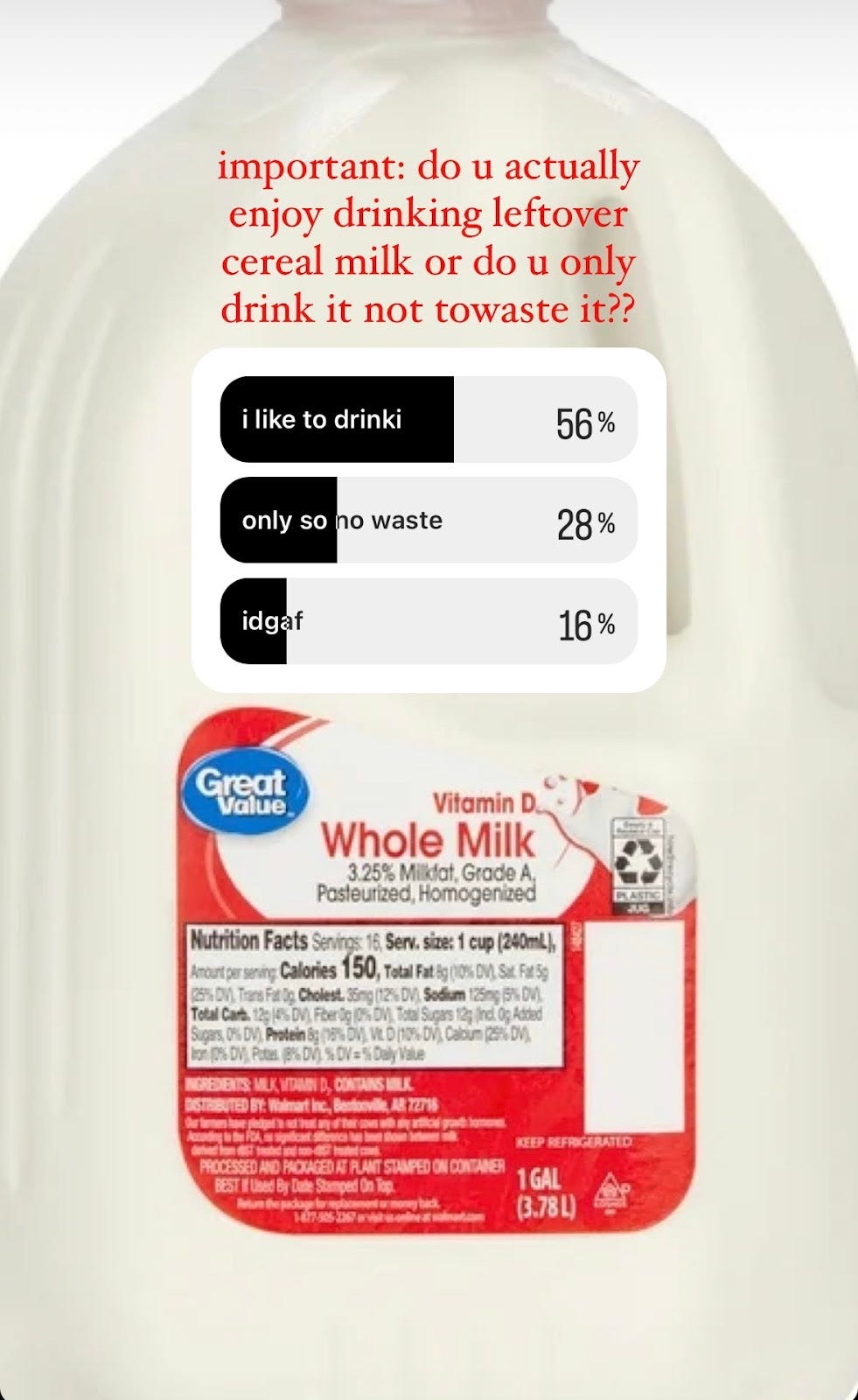
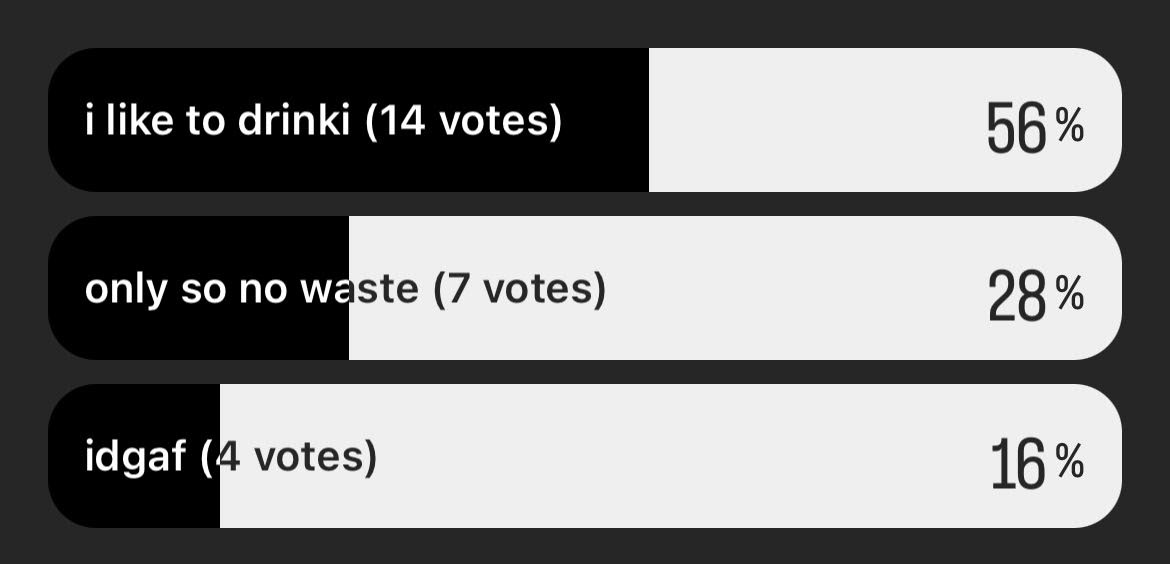
These steps and calculations can be taken by any individual to determine their necessary cereal and milk ratio. While the values generated in this study are only pertinent and useful to myself and my preferences, this procedure and system of equations factors in a range of individual differences and preferences from cereal type to differences in consumption ratio and all other relevant parameters and variables. Thus, if milk waste is a concern and drinking plain cereal milk is similarly disturbing to you like 28% of participants reported on a survey on cereal drinkability, the methods of this study may be useful to combat this issue.
The data collected in this study is limited due to several reasons including supply shortage and a mild stomach illness due to the sudden sharp consumption of sugary cereal. Although the procedure and calculations are valid and follow a clear logic, it is important to validate these calculations even further with additional cereal-eating trials to test the values generated from this study. A replication of this study will be conducted to verify these initial findings.
Conclusion
This study was an attempt to combat food waste and over-consumption on a micro-scale as well as draw attention to these issues and their large-scale impact on our environment and well-being. Through my pages-long and weeks-long obsession with these issues in possibly the most inane and arbitrary way, perhaps I have gained your attention, bewilderment, and maybe annoyance as well. It is possible you maybe be asking yourself (I may have as well), why couldn’t she just put this amount of time and effort into something that targets these issues much more effectively than ruminating over a negligible amount of milk at the bottom of a bowl of cereal? If so, I ask of you to direct that question back towards yourself. Can you put the same effort that I put into doing this research on becoming a better consumer and inhabitant of our planet? It doesn’t take very much, certainly, it takes much less than the work I put into this paper to make a noticeable impact. Things such as eliminating meat consumption once or twice a week to start, buying only what you need and making smaller and more frequent trips to the grocery store, or educating yourself on proper food storage techniques are a few of the ways you can begin to ameliorate the ongoing issues.
References
Bhatia, L., Jha, H., Sarkar, T., & Sarangi, P. K. (2023). Food Waste Utilization for Reducing Carbon Footprints towards Sustainable and Cleaner Environment: A Review. International journal of environmental research and public health, 20(3), 2318. https://doi.org/10.3390/ijerph20032318
Balan, I. M., Gherman, E. D., Brad, I., Gherman, R., Horablaga, A., & Trasca, T. I. (2022). Metabolic food waste as food insecurity factor—causes and preventions. Foods, 11(15), 2179. https://doi.org/10.3390/foods11152179
Food waste in America in 2024: Statistics & Facts: RTS. Recycle Track Systems. (n.d.). https://www.rts.com/resources/guides/food-waste-america
Gustavsson, J., Cederberg, C., Sonesson, U., & van Otterdijk, R. (2011). Global Food Losses and Food Waste. FOOD AND AGRICULTURE ORGANIZATION OF THE UNITED NATIONS.
UN: 17% of all food available at consumer levels is wasted. UN Environment. (n.d.). https://www.unep.org/news-and-stories/press-release/un-17-all-food-available-consumer-levels-wasted